|
|||||
|
|
|||||
|
This week, we look at a paradox in Africa’s health financing. |
|||||
|
|
|||||
Africa’s health paradoxFrom Dakar to Dar es Salaam, Accra to Addis, Lagos to Lilongwe, and Cairo to Cape Town, health budgets are rising. Clinics are opening, reforms are being announced, and governments are sharing progress reports. But for millions, health care remains a privilege, not a right. This is Africa’s health financing paradox: more money is flowing into health, yet fewer people are truly protected. If we continue on this path, we risk walking into a slow, preventable crisis with our eyes wide open. Why? Because:
As the world marks Universal Health Coverage Day under the theme “Unaffordable health costs? We’re sick of it!”, Africans are not asking for more reports, declarations, or compacts. They are calling for real solutions—bold, rooted, and homegrown. As the African proverb says, “When the roots are deep, there is no reason to fear the wind." To turn spending into protection, leaders must act decisively:
Health care should not be a gamble. Africans deserve systems they can trust, access they can afford, and leaders who choose people over promises. The time to act is now. And this time, let the drumbeat come from Africa. — Dr. William Nii Ayitey Menson, Director, Health Financing for Africa at ONE 3 things to know1. Africa’s health spending is both rising and stagnating. Health spending has grown by more than 160% since 2000. But much of that doesn’t come from governments (more on that below). And making matters worse, on a per person basis, health spending has plateaued over the past decade. That’s partly due to the fact that Africa’s population has increased by roughly one-third over that period. 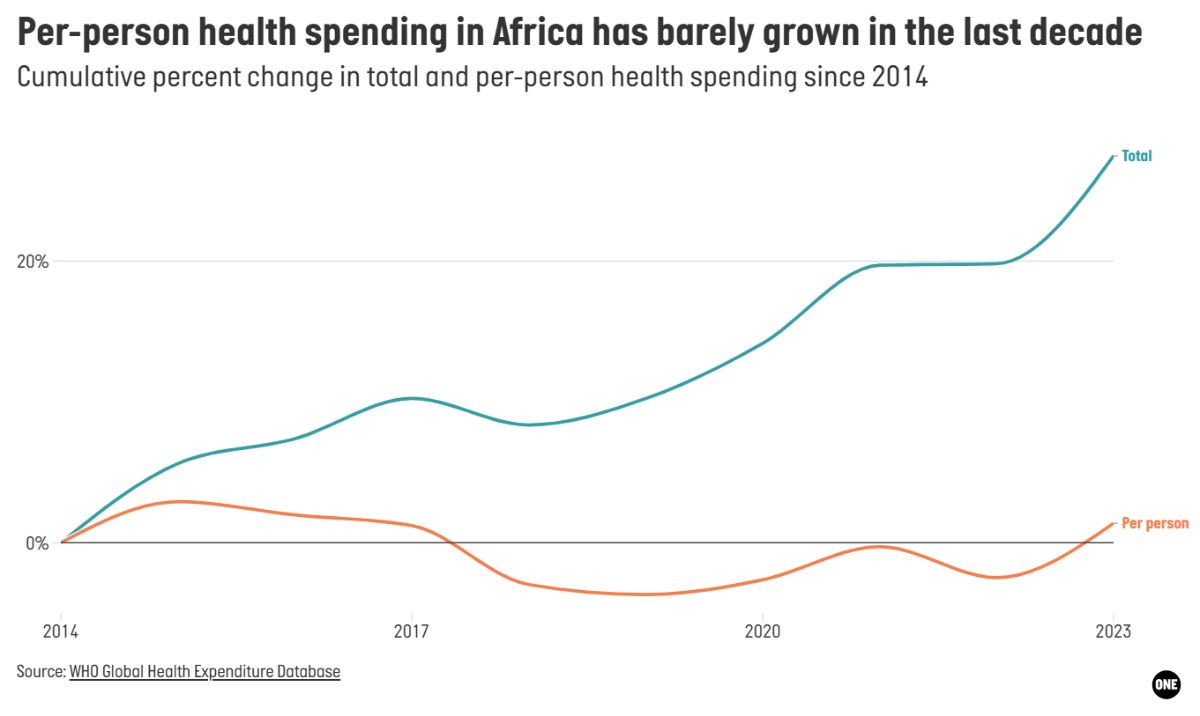 Explore an interactive version of the chart Why it matters: The WHO recommends that countries invest at least 4% of their GDP on health to achieve universal health coverage. But government health financing in Africa currently averages only 1.5% of GDP. To reach 4%, Africa’s domestic government health financing would need to increase by 169%. That’s a steep mountain to climb, especially considering that Africa’s health spending has risen by just 3% per capita over the past decade, a marginal increase effectively erased by inflation. 2. African citizens provide 37% of health financing out of pocket. That’s well above the WHO’s recommendation that out-of-pocket health spending be kept below 20%. The situation is even worse in Africa’s low- and lower-middle-income countries, where citizens spend 47% on health costs compared to just 32% from governments, on average. In Cameroon, Equatorial Guinea, and Nigeria, over two-thirds of health spending is paid out of pocket. 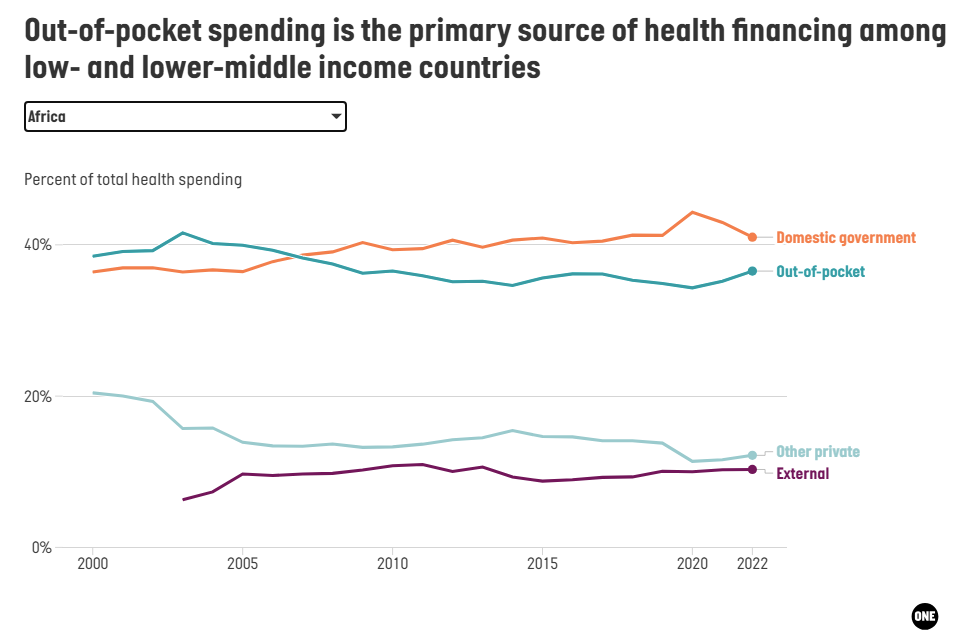 Explore an interactive version of the chart Why it matters: Out-of-pocket costs hit those with the least the hardest, particularly in lower-income countries, where families often are already experiencing economic hardship. In 2019 alone, out-of-pocket health spending pushed 344 million people into extreme poverty. 3. Only two countries have achieved Africa’s promised health spending. In 2001, African Union countries set a target—known as the Abuja Declaration—to allocate at least 15% of their annual budgets to health. As recently as 2023, African leaders recommitted to implementing the Abuja Declaration target. Yet only Cabo Verde and South Africa meet that level of health spending based on the most recent data. 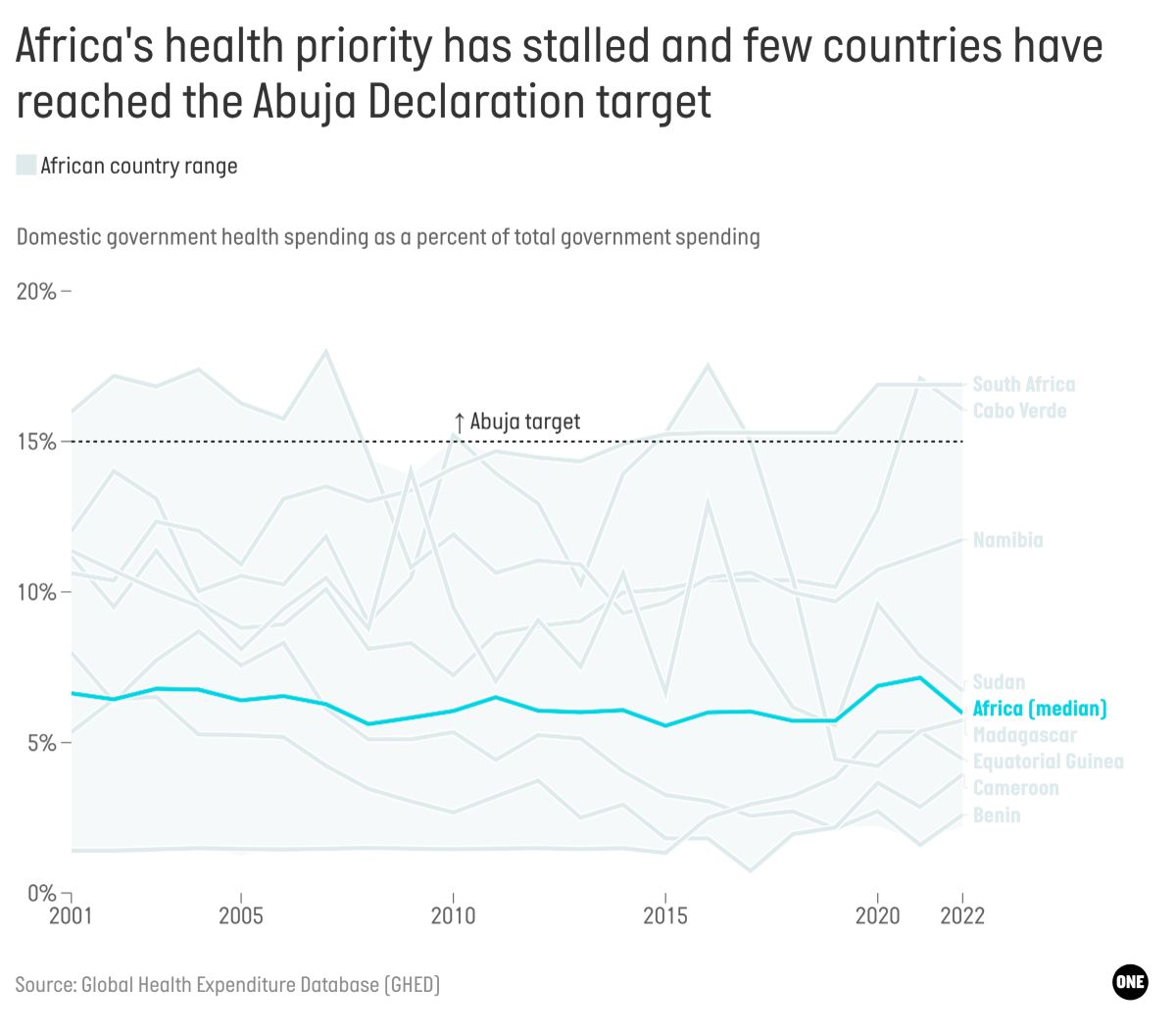 Explore an interactive version of the chart Why it matters: With external support falling due to aid cuts, African governments need to mobilise and maximise health financing. For instance, progressive taxation, digital levies, and stronger revenue collection could generate billions of dollars a year in new fiscal space for health. Financial innovations could enable some of the $100 billion in remittances sent to Africa from abroad to be channeled into healthcare via health savings accounts or prepaid insurance plans. African leaders will need to play a leading role in shaping the future of health in Africa. 
|
|||||
|
|
|||||
From the ONE Team:
|
|||||
|
|
|||||
In the Queue:
|
|||||
|
|
|||||
|
The ONE Campaign’s ONE Data provides cutting edge data and analysis on the economic, political, and social changes impacting Africa. Check it out HERE. |
|||||
|
|
|||||
Did you like today's email?
Loved it 
Mehhh 
Hated it |
|||||
|
|
|||||
|
|||||
|
This email was sent by ONE.ORG to test@example.com.
You can unsubscribe at any time. ONE Campaign |